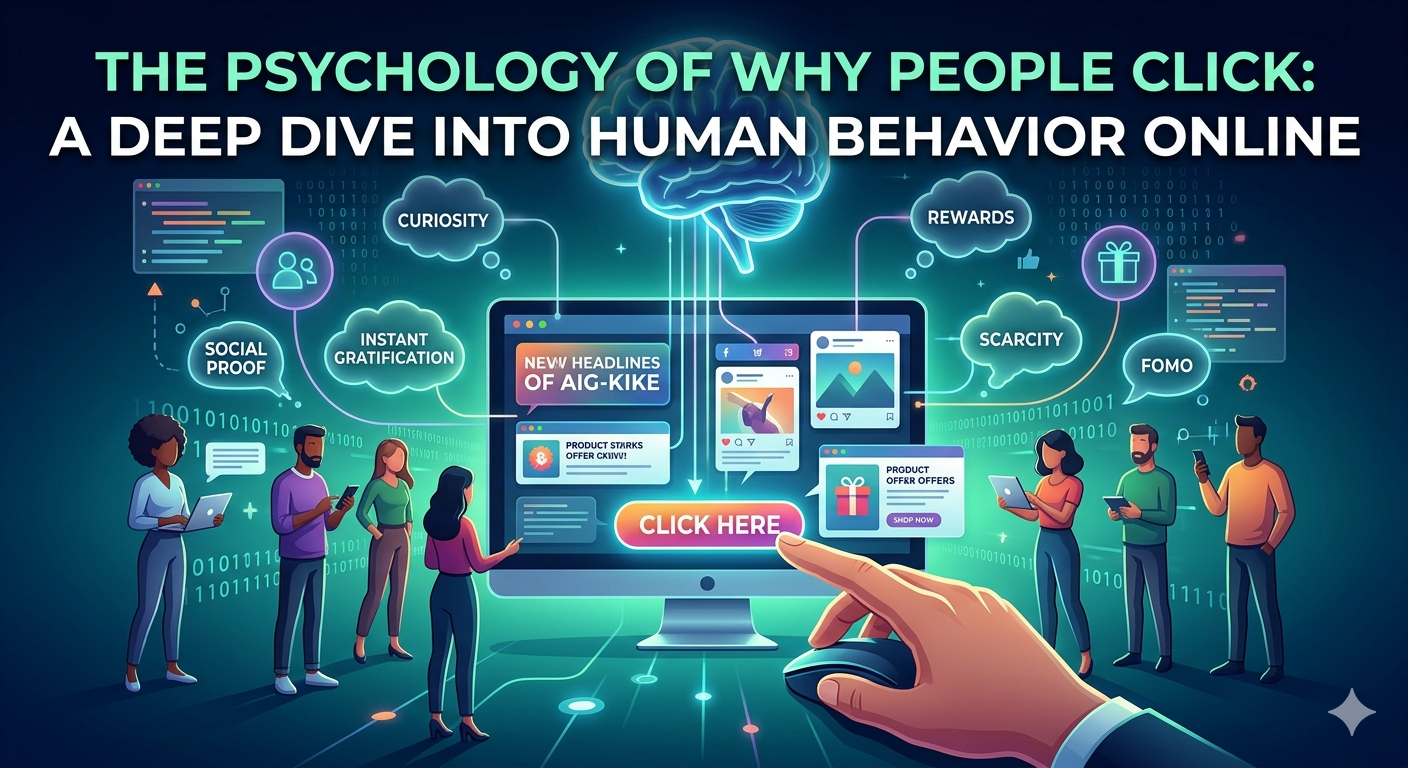
Clicks are the currency of the digital world. Every marketer, advertiser, and content creator knows this. But why exactly do people click? What drives that seemingly simple action? Understanding the psychology behind clicks is not just an academic exercise—it’s the key to designing campaigns that attract attention, engagement, and ultimately conversions.
In this comprehensive guide, we’ll explore the psychological principles that influence human behavior online, from curiosity gaps and fear triggers to social proof, novelty, and urgency. Whether you’re crafting headlines, designing landing pages, or planning ad campaigns, these insights will give you the tools to create content that resonates and converts.
Clicks as a Window into Human Attention
At its core, a click represents a conscious decision. A person has noticed your message, evaluated it—whether consciously or subconsciously—and decided it was worth engaging. This is why clicks are more than a metric; they are a signal of human attention and intent.
Unlike impressions or views, clicks indicate an active choice. Someone could scroll past hundreds of pieces of content in a day, but when they click, they’re giving you a fragment of their cognitive focus. Understanding what motivates this choice is the cornerstone of psychology-driven marketing.
The Curiosity Gap: Triggering the Need to Know
One of the most powerful psychological drivers of clicks is curiosity. Psychologists define curiosity as a desire to acquire new information. In digital marketing, this manifests as the curiosity gap.
The curiosity gap occurs when a person senses that there is missing information—something they want to know—but it is just out of reach. Headlines, ad copy, and subject lines that exploit this gap can dramatically increase CTR.
Examples of the Curiosity Gap
- “You Won’t Believe What Happens When You Try This Simple Marketing Trick”
- “The One Mistake That Could Kill Your Conversion Rate”
- “7 Secrets Copywriters Don’t Want You to Know”
These examples create a gap between what the reader knows and what they want to know. Our brains are wired to resolve uncertainty, which makes curiosity one of the most effective click triggers.
Why It Works
Research in cognitive psychology shows that humans experience a mild tension when knowledge is incomplete. This tension creates an internal drive to seek resolution. Online, a well-crafted curiosity gap makes clicking almost irresistible.
Fear Triggers: The Power of Anticipated Loss
Fear is another primal motivator. Humans are more sensitive to potential losses than equivalent gains—a principle known as loss aversion. In digital marketing, fear-based triggers can compel clicks when the content promises to prevent loss or avoid risk.
Common Fear Triggers in Marketing
- Missing out on limited offers (FOMO)
- Risk of making costly mistakes
- Urgency tied to deadlines or scarcity
For instance, an ad with the headline “Avoid These 5 Costly SEO Mistakes” activates fear by implying that failing to act could have negative consequences. Fear triggers are highly effective, but they must be used ethically. Manipulating fear without offering real value erodes trust over time.
Social Proof: Following the Crowd
Humans are social creatures. We often rely on the behavior of others to make decisions, especially when uncertain. This principle, called social proof, plays a critical role in click behavior.
When potential customers see that others have clicked, shared, or engaged with content, they are more likely to follow suit. This explains the effectiveness of testimonials, user counts, reviews, and social shares.
Types of Social Proof
- Expert Endorsements: Authority figures recommending a product or content
- User Numbers: “Join 50,000 marketers who use this tool”
- Testimonials: Stories of others’ positive experiences
- Ratings and Reviews: Star ratings, review counts, and public feedback
Integrating social proof into ads, emails, and landing pages signals trustworthiness, which reduces the perceived risk of clicking and increases engagement.
Novelty: The Brain’s Attraction to the New
Humans are naturally drawn to novel stimuli. Our brains are wired to pay more attention to things that are unusual, surprising, or different from the expected. This is why incorporating novelty into marketing campaigns can significantly boost CTR.
How Novelty Drives Clicks
- Unexpected phrasing in headlines
- Unusual visuals or formats
- New insights or counterintuitive findings
- Creative storytelling that breaks conventions
For example, a headline like “Why Everything You Know About SEO Is Wrong” leverages novelty by challenging existing assumptions, triggering readers to click to resolve the discrepancy between expectation and reality.
Urgency: Activating Immediate Action
Urgency creates the perception that action is required immediately. Time-sensitive offers, countdowns, and limited availability can all make users feel compelled to click.
Psychological Basis
Urgency taps into the scarcity principle. When people perceive that an opportunity may soon disappear, they assign it higher value and are motivated to act quickly. This can dramatically improve CTR when combined with compelling offers or messages.
Examples of Urgency in Digital Marketing
- “Only 24 Hours Left to Access This Free Webinar”
- “Limited Spots Available – Register Now”
- “Sale Ends Today – Don’t Miss Out”
Urgency is particularly effective when paired with clear value propositions. The key is to maintain credibility—false scarcity damages trust.
Combining Psychological Drivers for Maximum Effect
Effective marketing rarely relies on just one psychological principle. The most successful campaigns integrate multiple drivers, creating layers of motivation that compel clicks.
Example Campaign
Imagine a landing page for a productivity tool:
- Curiosity Gap: “The 3 Productivity Hacks You’ve Never Heard Of”
- Fear Trigger: “Don’t Waste Another Hour Struggling to Stay Focused”
- Social Proof: “Used by 25,000 Professionals Worldwide”
- Novelty: Interactive checklist that adapts to your workflow
- Urgency: “Sign Up Today to Get Free Access Before Slots Run Out”
When combined, these elements dramatically increase the likelihood that someone will click and engage.
The Ethical Use of Psychological Triggers
With great power comes great responsibility. While curiosity gaps, fear triggers, social proof, novelty, and urgency can boost CTR, they must be used ethically.
Misusing these techniques can result in:
- Clickbait fatigue
- Loss of trust
- Brand reputation damage
- High bounce rates and low conversions
The best marketers use these principles to provide value while motivating clicks. For example, curiosity gaps should tease genuinely valuable information, not deceive. Fear triggers should highlight real risks that your product or service can help mitigate.
Testing and Optimizing Click Behavior
Understanding human psychology is only part of the equation. Testing and optimization are crucial to translate insights into measurable results.
Key Strategies
- A/B Testing Headlines: Compare multiple versions to see which generates higher CTR
- Heatmaps and Analytics: Track where users click and how they interact with content
- Behavioral Segmentation: Test messages on different audience segments to identify what drives clicks
- Iterative Refinement: Continuously optimize campaigns based on real-world data
Data-driven adjustments ensure that psychological triggers are applied in ways that maximize engagement while maintaining user trust.
Beyond the Click: Linking Psychology to Conversion
Clicks are important, but they are the first step in a broader journey. Understanding the psychology of clicks allows marketers to design pathways that not only attract attention but also convert visitors into loyal customers.
For example, curiosity gaps that lead to valuable content can nurture leads over time. Fear triggers can highlight actionable solutions. Social proof reassures users as they move through the funnel. Novelty keeps users engaged, and urgency can motivate timely action at key moments.
By integrating these principles into the full marketing funnel, you ensure that clicks translate into meaningful business results, not just temporary spikes in engagement metrics.
Final Thoughts
The digital landscape is crowded. Millions of messages compete for human attention every day. Understanding why people click is no longer optional—it’s essential.
By leveraging psychological principles such as curiosity gaps, fear triggers, social proof, novelty, and urgency, marketers can craft campaigns that capture attention ethically and effectively.
Clicks are more than just numbers on a dashboard. They are windows into human behavior, signals of engagement, and opportunities to create lasting relationships with audiences.
When you understand the psychology behind clicks, you don’t just increase CTR—you create marketing that resonates, persuades, and converts.
Master these principles, and every click becomes a meaningful step toward your business goals.

Data-driven editor at CliqSpot, transforming raw analytics into actionable growth strategies for modern businesses.
Leave a Reply