Every successful advertising campaign begins with a simple question:
Why do some ads generate results while others are ignored?
In a digital environment saturated with content, high-performing ads are not created by chance. They are engineered through a combination of psychology, strategy, and precise execution.
Whether you’re running search ads, social media campaigns, or display advertising, the core components of effective ads remain consistent. Understanding these components allows marketers and website owners to build campaigns that not only attract clicks—but convert those clicks into revenue.
This guide breaks down the essential elements that define high-performing ads and shows you how to apply them in your own campaigns.
What Defines a High-Performing Ad?
A high-performing ad is not simply one that generates clicks. It is one that achieves business objectives efficiently.
That typically means:
- High click-through rate (CTR)
- Strong conversion rate
- Low customer acquisition cost
- Positive return on ad spend (ROAS)
To achieve these outcomes, every element of the ad must work together cohesively.
1. Headlines: The First Point of Contact
The headline is the most important component of any ad. It determines whether the audience stops, reads, and engages—or scrolls past.
In many cases, the headline alone is responsible for the majority of an ad’s performance.
What Makes a Strong Headline?
- Clarity: Clearly communicates what the user will gain
- Relevance: Speaks directly to the audience’s needs or problems
- Curiosity: Creates a desire to learn more
- Specificity: Uses concrete details instead of vague claims
Examples
- “How to Increase Website Conversions by 37% in 30 Days”
- “Stop Wasting Money on Ads That Don’t Convert”
- “The Simple Funnel Fix That Doubled Our Revenue”
Each of these headlines combines clarity with a compelling benefit, making it difficult for the reader to ignore.
For marketers, headline testing is one of the highest-leverage activities. Small improvements can lead to significant gains in CTR and overall performance.
2. Imagery: Capturing Attention Instantly
In visual platforms like social media and display networks, imagery plays a critical role in ad performance.
Before a user reads a word of copy, they process the image. That split-second impression often determines whether they engage further.
Characteristics of Effective Imagery
- Relevance: Matches the message and audience
- Clarity: Communicates the idea quickly
- Emotion: Evokes a feeling or reaction
- Contrast: Stands out from surrounding content
Images that feel native to the platform often perform better than overly polished or generic stock visuals. Authenticity tends to outperform perfection.
For example, a candid photo of a product in use may outperform a studio shot because it feels more relatable and trustworthy.
3. Offer Structure: The Core Value Proposition
The offer is the heart of the advertisement. Without a compelling offer, even the best creative will fail.
A strong offer answers one fundamental question:
Why should the user take action right now?
Elements of a Strong Offer
- Clear Value: What benefit does the user receive?
- Specific Outcome: What result can they expect?
- Risk Reduction: Guarantees, trials, or refunds
- Incentive: Discounts, bonuses, or exclusive access
Examples of Strong Offers
- “Start Your Free 14-Day Trial—No Credit Card Required”
- “Get 25% Off Your First Order Today Only”
- “Download the Free Guide That Helped 10,000 Marketers Increase CTR”
Offers that reduce friction and increase perceived value consistently outperform those that rely solely on product features.
4. Targeting: Reaching the Right Audience
Even the most well-crafted ad will fail if it is shown to the wrong audience.
Targeting ensures that your message reaches individuals who are most likely to be interested in your product or service.
Key Targeting Dimensions
- Demographics: Age, gender, income, location
- Interests: Hobbies, behaviors, preferences
- Intent: Search queries, browsing behavior
- Custom Audiences: Retargeting past visitors or customers
High-performing campaigns often rely heavily on audience segmentation. Instead of creating one generic ad, they tailor messaging to specific groups.
For example, a SaaS company might create separate campaigns for:
- New visitors
- Returning users
- Trial users who haven’t converted
Each audience receives messaging that reflects their position in the buying journey.
5. Landing Page Alignment: Delivering on the Promise
One of the most overlooked aspects of advertising performance is what happens after the click.
A high-performing ad must be aligned with its landing page.
This means that the experience a user encounters after clicking should match the expectations set by the ad.
Common Alignment Issues
- Ad promises one thing, landing page delivers another
- Messaging is inconsistent between ad and page
- User must search for the offer instead of seeing it immediately
Best Practices for Alignment
- Repeat the headline or key message on the landing page
- Highlight the same offer prominently
- Maintain visual consistency (colors, imagery, tone)
- Reduce distractions and guide users toward conversion
When alignment is strong, conversion rates increase significantly because users feel confident that they are in the right place.
How These Elements Work Together
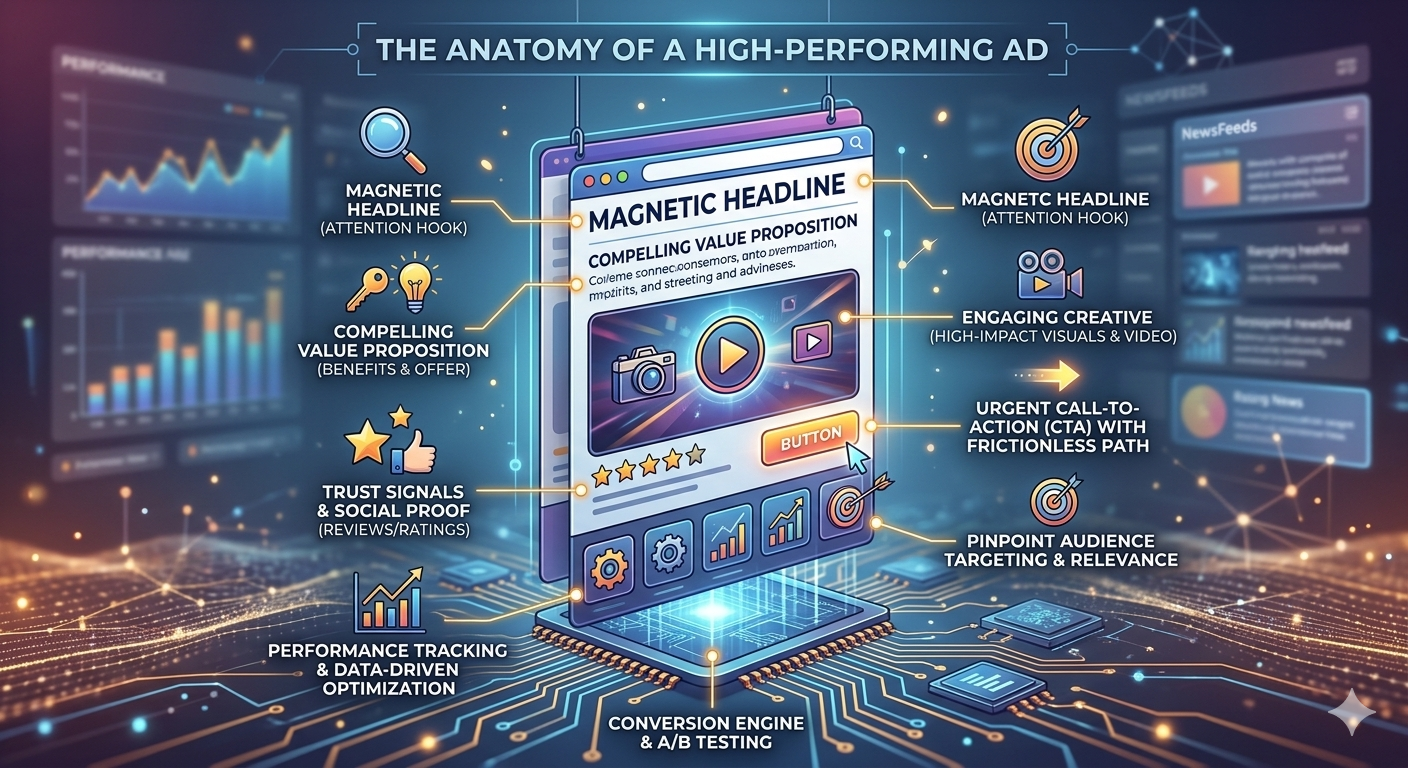
A high-performing ad is not defined by a single element. It is the result of multiple components working together seamlessly.
Consider the flow:
- The headline captures attention
- The imagery reinforces interest
- The offer creates motivation
- The targeting ensures relevance
- The landing page converts interest into action
If any one of these elements is weak, overall performance suffers.
For example, a strong headline paired with poor targeting may generate clicks but few conversions. Likewise, a compelling offer paired with weak landing page alignment may result in lost opportunities.
Common Mistakes That Hurt Ad Performance
Understanding what works is only part of the equation. Avoiding common mistakes is equally important.
Over-Optimizing for CTR
Focusing solely on clicks can lead to misleading results. High CTR does not guarantee high revenue.
Weak or Generic Offers
Ads that fail to communicate clear value struggle to motivate action.
Poor Audience Targeting
Showing ads to the wrong audience wastes budget and reduces efficiency.
Inconsistent Messaging
Misalignment between ad and landing page creates confusion and reduces trust.
Testing: The Key to Continuous Improvement
No ad is perfect on the first attempt. High-performing campaigns are built through testing and iteration.
What to Test
- Headlines
- Images or videos
- Offers
- Audience segments
- Landing page variations
Even small changes can produce significant improvements. Testing allows marketers to identify what resonates most with their audience and refine campaigns accordingly.
Final Thoughts
High-performing ads are not created through guesswork. They are the result of deliberate design, grounded in an understanding of human behavior and strategic execution.
By focusing on the key components—headlines, imagery, offer structure, targeting, and landing page alignment—you can create campaigns that not only attract attention but also drive meaningful results.
In a competitive digital landscape, success belongs to those who understand not just how to generate clicks, but how to turn those clicks into value.
Master the anatomy of a high-performing ad, and you gain control over one of the most powerful levers in modern marketing.

Data-driven editor at CliqSpot, transforming raw analytics into actionable growth strategies for modern businesses.
Leave a Reply