Digital Marketing · Paid Media · Strategy
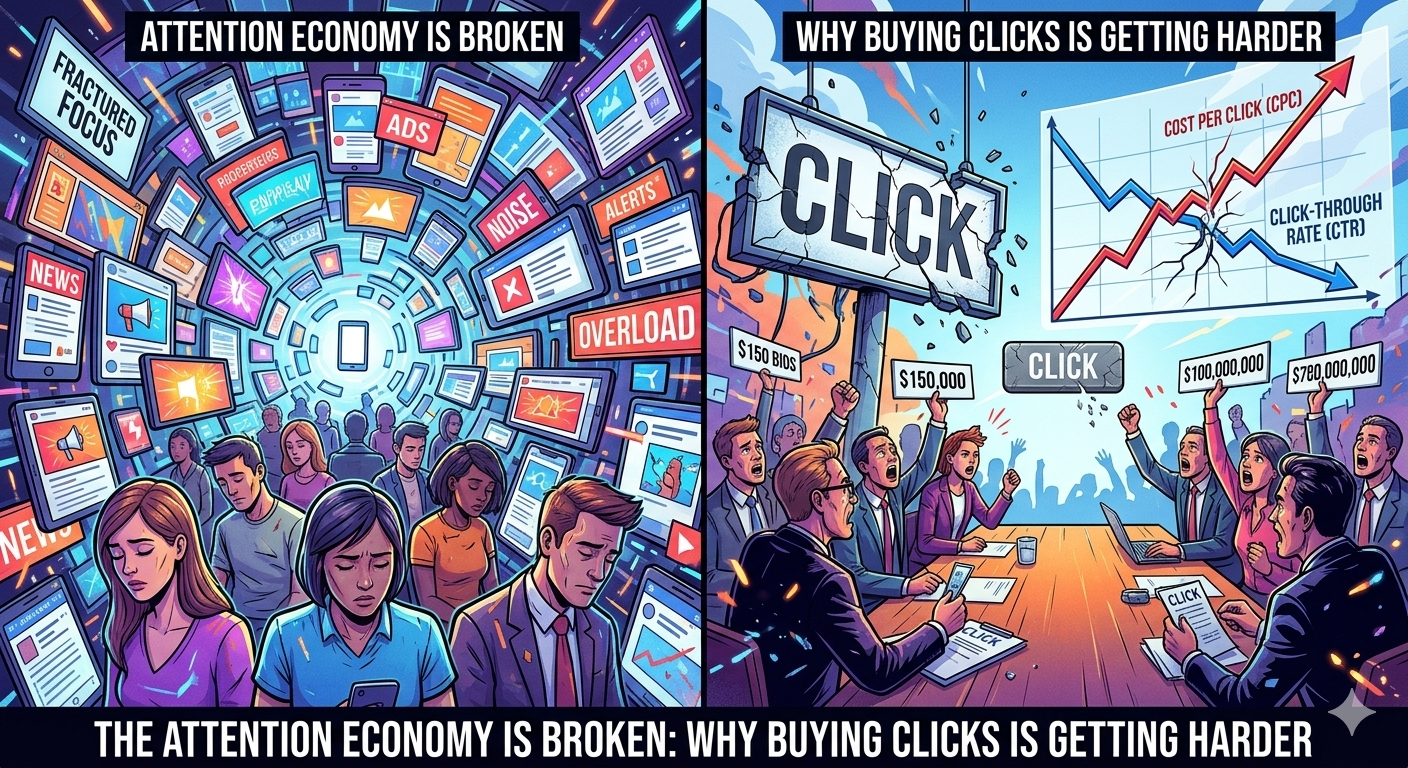
The Attention Economy Is Broken: Why Buying Clicks Is Getting Harder
For two decades, digital advertising operated on a simple premise: pay for access to human attention and reap the returns. That premise is now unraveling — pulled apart by AI-generated answers, privacy walls, auction algorithms, and a user population that has quietly learned to look away.
There is a moment every senior marketer eventually faces. You open the dashboard on a Monday morning and the numbers are right there, unchanged and damning: the same budget, the same campaigns, the same targeting — and fewer clicks than last quarter. You check the math. You blame the creative. You suspect the platform changed something. And then, slowly, it dawns on you that nothing is broken. This is just what digital advertising looks like now.
The attention economy — that sprawling, multi-trillion-dollar apparatus built on the premise that human focus can be measured, packaged, and sold — is under structural strain unlike anything it has faced since the rise of programmatic buying a decade ago. The forces reshaping it are not temporary. They are geological: moving slowly enough to be ignored quarter by quarter, yet powerful enough to have already fundamentally redrawn the map.
This article is a reckoning with those forces. It is also a guide to what comes next — not in the vague, trend-deck sense, but with specificity about where the real opportunities lie for brands willing to rethink what they are actually buying when they buy attention.
I. How We Built a Machine That Feeds on Itself
To understand why buying clicks is getting harder, you have to understand the structural logic of the platforms themselves. Google, Meta, and the programmatic ecosystem that orbits them were designed as auctions. The more advertisers compete for a finite pool of attention, the higher prices go. For a decade and a half, this was masked by one elegant fact: the pool was growing. New users came online. Mobile unlocked inventory that didn’t exist. The addressable audience expanded faster than ad spend, and so prices stayed manageable.
Then the pandemic hit. E-commerce adoption jumped roughly 34% in 2020 alone — the equivalent of five years of digital maturity compressed into eighteen months. Businesses that had been slow to embrace digital marketing were suddenly forced onto the platforms. They didn’t leave when restrictions lifted. They doubled down. Google’s ad revenue surged 42.6% between 2020 and 2021. The demand side of the auction exploded. The supply side — human attention — did not.
The arithmetic of this imbalance is now playing out in every campaign dashboard across every industry. CPC inflation in most verticals runs at 4–12% annually, well ahead of general consumer price inflation. In B2B software, legal, and financial services, the numbers are more violent: some advertisers have seen cost-per-click rise 50–100% over the last three years. Insurance keywords on Google Search now average $16.54 per click. LinkedIn CPC has, by some measurements, risen 147% across major accounts. Meta’s average price per ad jumped 10% in 2024 alone, with some forecasts projecting a further 14% rise in 2025.
“This isn’t a temporary spike that’s going to return to 2019 pricing. The fundamental digital advertising landscape has changed permanently.”
— Industry consensus from multiple ad benchmarking reports, 2025
And yet, budgets keep flowing in. Global digital ad spend reached $790 billion in 2024, accounting for 72.7% of all worldwide advertising investment. The money going into the machine has never been larger. The return on that money has quietly, consistently been getting worse.
II. The Zero-Click Catastrophe
If rising CPCs are the slow burn, zero-click search is the accelerant. The statistic has become a fixture of every digital marketing conference in the past two years, but its implications are still not fully metabolised by most organisations: approximately 65% of all Google searches in mid-2025 ended without a click to any external website — up from roughly 25% just five years ago.
For every 1,000 Google searches conducted in the United States, only around 360 clicks reached the open web. The rest were answered — or at least, were perceived to have been answered — on the results page itself. Featured snippets. Knowledge panels. Local packs. Direct answer boxes. Weather widgets. And, increasingly, AI Overviews.
The AI Overview Effect
When Google expanded its AI Overviews in 2024, it changed the topology of the search results page in ways that are still rippling through the advertising ecosystem. Overviews appeared for around 6.5% of queries in January 2025, rose to nearly 25% by mid-summer, and settled at approximately 15.7% by November 2025. The key thing is not the percentage — it’s what Overviews do to click behaviour when they appear.
A study examining over 25 million impressions found that on queries where an AI Overview appeared, paid click-through rates collapsed from 19.7% to 6.34% — a 68% drop. Organic CTR fared even worse in percentage terms, falling from 1.76% to 0.61%, a 61% decline. A separate analysis found that sites targeting informational queries — the kind that seed the top of most marketing funnels — lost up to two-thirds of their traffic once AI Overviews rolled out for their category.
The mechanism is simple and merciless. When Gemini generates a summary answer at the top of the page, it satisfies the user’s informational intent before they ever see an ad. The user gets their answer, closes the tab, and goes about their day. The advertiser paid for the auction slot. Nobody came.
-
2015
Google launches Featured Snippets, beginning the era of on-SERP answer delivery. Zero-click rates hover near 25%. -
2019
Knowledge Panel expansion aggregates vast swaths of factual information. Zero-click approaches 50% of all queries. -
2024
AI Overviews launch widely. Paid CTR drops 68% on affected queries. Zero-click reaches 58.5% in the US. -
2025
Zero-click surpasses 65% globally. AI Overview prevalence doubles in two months. 96.55% of published content receives zero organic traffic from Google. -
Next
“Zero-search discovery” begins: AI proactively surfaces recommendations before users even form a query — the final frontier of the click’s extinction.
The cruel irony is that Google’s search volume is not shrinking. The platform processed an estimated 9.1 to 13.6 billion searches per day in 2025, up from 8.5 billion in 2024. People are searching more. They’re just clicking less. The search results page has ceased to be a gateway and has become the destination.
III. The Privacy Reckoning
Layered on top of the zero-click crisis is a privacy revolution that has systematically dismantled the targeting infrastructure that made digital advertising compelling in the first place. The story of the last five years in ad tech is, in large part, the story of data disappearing.
Apple’s App Tracking Transparency framework, launched in 2021, immediately reduced Facebook’s ability to track iOS users for retargeting. Meta’s reported revenue loss from that single policy change was estimated in the tens of billions. The deprecation of third-party cookies — long delayed, now genuinely in progress — is removing the connective tissue that allowed advertisers to follow users across the web, build behavioural profiles, and serve relevant ads at the right moment in the purchase journey.
The result is that the targeting precision that justified premium CPCs is eroding. Advertisers who once ran tightly segmented campaigns are now being pushed toward broader match types, algorithmic delivery, and black-box optimisation. Google made broad match the default in its search campaigns. Meta’s Advantage+ increasingly overrides manual audience selections. The platforms are telling marketers to trust the machine — and the machine, in many cases, is spending budgets less efficiently than a skilled human operator would have just three years ago.
“Privacy changes have made targeting less efficient. Advertisers cast wider nets, leading to lower efficiency and higher CPCs. This is the new tax on ignorance about your own customer.”
— Synthesis of 2025 agency and platform research
The platforms benefit from this opacity. When advertisers can’t precisely measure what is working, they tend to spend more broadly, not less. The shift to Privacy Sandbox, server-side tagging, and modelled conversions has introduced uncertainty at every step of the attribution chain. Marketers lose clarity. Budgets expand defensively. Platform revenues rise.
IV. The Algorithm Auction Trap
There is a third force compressing ROI that receives less attention than AI Overviews or privacy changes, but may be the most structurally significant: the automation of bidding has created a prisoner’s dilemma from which advertisers cannot escape.
Over 80% of Google advertisers now use some form of Smart Bidding. On Meta, Advantage+ has become the default campaign structure. These algorithmic systems are, in isolation, intelligent. They optimise toward stated objectives, dynamically adjust bids, and identify conversion signals at speeds no human could match. The problem emerges in aggregate: when every advertiser’s algorithm is chasing the same high-intent signals on the same population of users, the auction prices for those users spike dramatically.
Google’s Smart Bidding Exploration feature deliberately loosens ROAS targets during a “learning phase” to capture exploratory queries. This is good for Google (more spend flows through the auction) and potentially good for individual advertisers (new audiences discovered) but tends to raise average CPCs during the exploration window. The more advertisers adopt the feature, the more CPCs rise for everyone.
One analysis found that when AI Overviews are present on a search results page, the number of above-the-fold text ads drops by 19–26% depending on the industry. Fewer ad slots. Same number of advertisers competing. Elementary supply-and-demand economics dictates the outcome: prices go up.
V. The Engagement Paradox
Here is the contradiction that sits at the heart of every media plan in 2026: brands are paying more money to reach users who are engaging with their ads less. Social media engagement rates have declined consistently across every major platform. Facebook engagement fell approximately 36% between 2022 and 2025. Yet CPMs on Meta, TikTok, Snapchat, and YouTube are all projected to rise in 2025, with TikTok leading at a projected 15.6% year-over-year growth in CPM.
This is the attention economy’s fundamental dysfunction: the metric that platforms sell — impressions, reach, potential exposure — has become decoupled from the metric that actually moves business — meaningful engagement leading to conversion. An impression scrolled past in 0.4 seconds is not the same as an impression that creates brand recall, consideration, or purchase intent. But it is priced as though it were.
The consequence is a systematic overinvestment in quantity and underinvestment in quality. A campaign that buys two million low-quality impressions may show healthier reach metrics than one that earns fifty thousand deeply engaged interactions — even if the second produces ten times the downstream revenue. As inventory grows and attention stays flat, buying eyeballs becomes less meaningful. What matters is earned attention, not purchased exposure.
VI. What to Do About It: The Practitioner’s Playbook
None of this is an argument for abandoning paid media. It is an argument for fundamentally rethinking what you are buying, how you are measuring it, and where your real leverage lies in a landscape that has permanently changed. Here is where the evidence points.
1. First-Party Data Is the New Moat
The brands performing best in the current environment share one characteristic above almost all others: they have invested systematically in first-party data. Email lists. SMS programmes. Loyalty databases. CRM integrations fed back into ad platforms as custom audiences and lookalikes. These are not just retention tools — they are targeting assets that appreciate in a world of privacy regulation.
The mathematics are compelling. As third-party targeting erodes, brands with rich first-party data can maintain precision targeting while competitors are forced into broad, inefficient audiences. That precision translates directly to lower CPCs (higher relevance scores), higher conversion rates, and lower cost-per-acquisition. The investment in building owned audiences is not a cost — it is an arbitrage against future CPC inflation.
2. Win the Citation Race, Not Just the Keyword Auction
In a world where AI Overviews answer questions before users click, the most valuable form of visibility is not an ad placement — it is a citation inside the AI response itself. The data on this is stark: brands cited within AI Overviews earn 35% more organic clicks and 91% more paid clicks compared to those that are not cited. Being in the AI answer is worth more than being in the first paid position below it.
This requires a new practice: Generative Engine Optimisation (GEO). Unlike traditional SEO, which optimises for rank position, GEO optimises for citation probability. The principles differ meaningfully. GEO rewards comprehensive, authoritative, structured content with clear factual claims and cited sources. It rewards FAQ schema, conversational query targeting, and content that directly answers questions AI systems are likely to synthesise.
B2B marketers, in particular, should note that 88.1% of queries triggering AI Overviews are informational — precisely the kind of content that seeds B2B buying journeys. If your thought leadership content is not appearing in AI-generated answers, your top-of-funnel strategy has a structural gap.
3. Diversify Before You’re Forced To
One of the consistent findings across agency research in 2025 is that B2B advertisers have weathered the CPC crisis better than their B2C counterparts. The key differentiator: B2B marketers had already diversified into non-auction channels — email sequences, webinars, organic LinkedIn, direct outreach — before the auction costs made diversification urgent. B2C brands that had concentrated budget in Google and Meta found themselves with ROAS contracting 15–20%; B2B advertisers saw only a 10% ROAS decline because their mix was healthier.
The channels worth prioritising as alternatives or complements to paid search and social include: Connected TV (where inventory expansion has been deflationary — Netflix’s CPM dropped from ~$42 in Q1 2024 to ~$31 by early 2025 as streaming platforms competed for budget); retail media networks (which now capture 21.2% of global digital ad spend, double their 2019 share, and offer purchase-intent targeting that search cannot match); and creator-led content (which consistently outperforms brand-produced creative on CTR and conversion).
4. Measure Differently
Many campaigns that look broken by traditional metrics are actually performing. AI-referred traffic, for example, converts at 23x the rate of traditional organic traffic. It accounts for a tiny fraction of total visits but a disproportionate share of revenue. If your attribution model treats a session from a ChatGPT recommendation the same as a bounce from a display impression, you are systematically undervaluing your most powerful acquisition channel while overvaluing your weakest.
The shift required is from click-centric metrics to outcome-centric metrics: cost per qualified conversation, customer lifetime value relative to acquisition cost, pipeline influenced by content, brand search volume as a proxy for awareness health. These are harder to automate and harder to report in real-time dashboards — which is precisely why organisations willing to invest in them gain a durable edge over those still optimising for cost-per-click on a shrinking pool of clicks.
5. Obsess Over Creative, Not Just Targeting
In the era of algorithmic delivery — where platforms increasingly override audience targeting and handle distribution themselves — the remaining lever in the hands of advertisers is creative quality. This is not a soft, qualitative statement. It is a structural argument about how ad auctions work. Quality Score on Google rewards creative relevance with lower CPCs. A 10% improvement in Quality Score can translate to 10% lower CPCs and improved placement — a compounding return on creative investment.
The implication is that the budget allocation between media spend and creative production, which has historically skewed heavily toward media, needs to rebalance. The brands that extract the best performance from their audiences are those that can iterate creative rapidly, test formats aggressively, and respond to engagement signals within days rather than quarters.
-
1
Owned audiences — Email, SMS, communities, loyalty programmes. Zero cost-per-reach, infinite reuse. The only attention that compounds in value. -
2
AI citations — Content optimised for inclusion in AI Overviews, ChatGPT, Perplexity. Generates high-intent, high-converting traffic at no incremental spend. -
3
Earned attention — Creator partnerships, PR, organic social. Borrows the audience trust of third parties without paying auction prices for it. -
4
Paid media — transactional — High-intent, bottom-funnel search and shopping for users already in buying mode. Worth premium CPCs. Everything else in this category needs scrutiny. -
5
Paid media — awareness — CTV, programmatic display, social video. Only justifiable if you can track its contribution to owned audience growth and branded search volume.
VII. The Uncomfortable Truth About What This Means
The attention economy is not dying. It is redistributing. The platforms will continue to extract enormous revenues — Meta generated $160.6 billion in advertising revenue in 2024. Google’s total ad revenue approaches $200 billion annually. The money flowing through digital advertising will keep growing. What is dying is the relatively effortless arbitrage that made performance marketing feel like a growth hack rather than a discipline.
For a decade, performance marketing teams could outpace their organic and brand-building counterparts by simply buying more clicks. The channels were underpriced, the targeting was precise, and the attribution was (apparently) clear. That era is over. Clicks have become expensive, targeting has become imprecise, and attribution has become murky — all simultaneously.
What replaces it is something both harder and more durable: marketing built on genuine audience relationships, authoritative content, and creative excellence rather than targeting technology. The brands that will win the next decade of digital marketing are not those with the best bidding algorithms. They are those with the deepest first-party data, the most cited content, and the most compelling creative — advantages that cannot be bought at any CPC.
“Zero click is taking over everything. Google is trying to answer searches without clicks. Facebook is trying to keep people on Facebook. LinkedIn wants to keep people on LinkedIn.”
— Rand Fishkin, SparkToro, 2025
The attention economy is broken in the way that a saturated market is broken: there is too much demand chasing too little genuine supply, and the price signals that result are distorting investment decisions at scale. The organisations that recognise this first — and begin building the infrastructure of owned, earned, and cited attention before their competitors do — will find that the broken economy has created its own form of opportunity. The window, however, is narrowing.
The marketers who will look back on 2026 as a turning point are those who stopped asking “how do I buy more clicks?” and started asking “how do I become worth clicking on?” That is not a semantic shift. It is an entirely different theory of the business. And it is, at this point, the only strategy with a viable long-term return.
Data sources referenced in this article include: IAB/PwC Internet Advertising Revenue Report (2024); eMarketer 2025 Media Inflation Forecasts; Semrush 10M-keyword AI Overviews study (2025); Seer Interactive analysis of 25.1M impressions (2025); SparkToro zero-click search studies; WordStream industry CPC benchmarks; Similarweb traffic analysis; Market Vantage CPC inflation compilation; DAC Group media inflation report Q1 2025; DataReportal Digital 2025 Global Advertising Trends.

Data-driven editor at CliqSpot, transforming raw analytics into actionable growth strategies for modern businesses.
Leave a Reply